
11/25/23
Role of nanotechnology in Covid remedy
Nanotechnology has played and continues to play a significant role in various aspects of addressing the COVID-19 pandemic.
Diagnostic Tools:
Nanoparticle-based Tests: Nanoparticles have been utilized in the development of diagnostic tests for COVID-19. These tests may use nanomaterials to enhance sensitivity and specificity, allowing for rapid and accurate detection of the virus.
Nanobiosensors: Nanotechnology has facilitated the creation of highly sensitive biosensors that can detect viral particles or antibodies associated with COVID-19. Nanoscale materials like graphene or quantum dots can be integrated into these sensors for improved performance.
Vaccine Development:
Nanoparticle-based Vaccines: Some COVID-19 vaccines use nanotechnology to deliver the viral antigens or genetic material. Lipid nanoparticles, for example, have been employed as carriers to enhance the stability and efficacy of mRNA vaccines.
Nanocarriers for Adjuvants: Nanoparticles can be used to deliver adjuvants, substances that enhance the body's immune response to vaccines. This can contribute to the development of more effective vaccines against COVID-19.
Drug Delivery Systems:
Nanoparticle Drug Delivery: Nanotechnology offers advanced drug delivery systems that can improve the targeting and release of antiviral drugs. These systems can enhance drug stability, bioavailability, and reduce side effects.
Nanomaterials for Antiviral Agents: Nanoparticles with antiviral properties can be designed to inhibit the entry of the virus into host cells or disrupt its replication. These materials may be used in the development of therapeutic agents for COVID-19.
Personal Protective Equipment (PPE):
- Nanomaterial-enhanced Fabrics: Nanotechnology has been applied to improve the performance of PPE, such as face masks and protective clothing. Antimicrobial nanoparticles can be incorporated into fabrics to provide additional protection against viruses.
Surface Coatings:
- Nanocoatings for Surfaces: Nanotechnology has been employed to create antiviral coatings for various surfaces. These coatings can help prevent the spread of the virus by reducing its viability on surfaces commonly touched by people.
Therapeutic Approaches:
- Nanoparticle-based Therapeutics: Nanoparticles can be designed to deliver therapeutic agents directly to the site of infection. This targeted approach can enhance the effectiveness of treatments for COVID-19.
Monitoring and Surveillance:
- Nanoscale Sensors: Nanotechnology contributes to the development of advanced sensors for monitoring air quality, detecting viral particles, and providing real-time data for public health surveillance.
11/25/23 0
Use of nanotechnology in precious metal processing
Nanotechnology has found applications in various industries, including precious metal processing, where it can enhance efficiency, reduce environmental impact, and improve the overall performance of extraction and refining processes. Some notable uses of nanotechnology in precious metal processing include:
4/30/15

Nano concrete
Addition of nano particles gives significant improvement to concrete than conventional concrete. Addition of nano particles improves the bulk properties of materials by controlling or manipulating at the atomic scale due to nanoscale attack by alkali silicate reaction. It is possible to obtain thinner final products and faster setting time besides lower levels of environmental contamination.
Nano concrete is a concrete made with Portland cement particles that are less than 500nm as a cementing agent as against normally used cement particle which range in size from a few nano-meters to a maximum of about100 micro meters. The benefits are cessation of contamination caused by micro silica solid particles, lower cost per building site, high initial and final compressive and tensile strengths, good workability, cessation of super plasticizing utilization and cessation of silicosis risk of concrete.
Nanomaterials used are nano-silica (nano-SiO2), nano-titanium oxide (nano-TiO2), nano-iron (nano-Fe2O3), nano-alumina (nano-Al2O3), nanoclay particles, and nanotubes/nanofibers (CNTs/CNFs) of nano-SiO2.
Nanosilica
Nanosilica is the first nano product that replaced the micro silica and is superior to silica used in conventional concrete. It makes high compressive strengths concretes (15 MPa and 75 MPa at 1 day; 40 MPa and 90 MPa at 28 days and 48 MPa and 120 MPa at 120 days). The advantages are high workability with reduced water/cement ratio with no need of super plasticizing additives. It fills up all the micro pores and micro spaces and saves cement up to 35-45%.
Titanium oxide
Titanium dioxide is a widely used white pigment. It can oxidize oxygen or organic materials, and so added to paints, cements, windows, tiles, or other products for sterilizing, deodorizing and to give anti-fouling properties. When added to outdoor building materials, it can substantially reduce concentrations of airborne pollutants. When exposed to UV light, it becomes increasingly hydrophilic, and can be used for anti-fogging coatings or self cleaning glass panes.
Polycarboxylates
Polycarboxylates or polymer based concrete admixtures are high range water reducing admixture. Higher dosage-produces self compacting concrete and this admixture type is very suitable for concrete used in constructions made underwater. They produce high resistance even with low addition up to 1.5 % of the cement weight and gives self compacting characteristics. Resistance to compression is from 40 to 90MPa in 1 day and from 70 to 100 MPa or more in 28 days.
Carbon nanotubes
CNT are highly flexible, mechanically stronger, have stiffest and strongest fibers of cylinders with nanometer diameter, several millimeters in length, 5 times the Young’s modulus and 8 times (theoretically 100 times) the strength of steel whilst being 1/6th the density and very high thermal conductivity along the axis.
4/30/15 3

Dengue Fever
Dengue infection is usually associated with tropical countries and causes high fever, headache, rash, severe joint and muscle pain, haemorrhage, and death. Dengue infection is caused by any one of four related viruses that are transmitted to humans by the mosquitoes.
There is no vaccine against dengue; nor have any specific antiviral medications shown to be effective to treat it. An effective vaccine would need to induce the immune system to produce antibodies against all four dengue virus serotypes, a task that so far has proven too difficult to accomplish and development and testing of antiviral medications is complicated and expensive. For dengue prevention and treatment the only existing ways are to control the mosquito populations responsible for transmitting the disease and to avoid being bitten by infected mosquitoes.
Researchers of James Cook University use nanotechnology to monitor a small protein that binds to antibodies, enabling it to be used to identify the potentially lethal diseases within hours, rather than days, of the pathogens infecting the human body. Research team has already discovered the protein basis of the technology, called Tus which is a small protein found in bacteria such as E. coli, also found in the human intestines, that binds strongly to DNA.
DNA bar coding
Researchers claim that the mechanism could be used to create a synthetic version of the protein/DNA interaction, allowing for ultrasensitive detection of the antibodies the human body developed, in response to invading bacteria or viruses. The process has been described as "DNA bar coding'' of tropical diseases. The researcher claims that it is easy to potentially detect one molecule in a reaction, compared to other techniques where they would need the millions of molecules involved in the interaction (within the human body), to be able to detect it, because it is so insensitive.
Portable dengue diagnosis
Researchers at the Australian Institute for Bioengineering and Nanotechnology (AIBN) are developing a portable diagnostic kit to test for dengue fever. The kit will contain a micro patch to draw a small amount of fluid from the skin and detect the presence of the disease by on-the-spot diagnosis eliminating a need to collect blood. The technology has the potential to screen for many diseases at once, allowing for fewer tests; earlier detection and treatment, and a significant reduction in illness and death.

Diabetes is a chronic disease that affects global population. Diabetes mellitus is a commonly seen chronic disease, which seriously threatens the health of human beings. Diabetic patients control their blood-sugar levels via insulin introduced directly into the bloodstream using injections. However effective monitoring and treatment options are important.
Nanotechnology offers some new solutions in treating diabetes mellitus. Nanotechnology, particularly nanoparticles show great promise in improving the treatment and management of diabetes.
Insulin and blood sugar
A new method uses nanotechnology to rapidly measure minute amounts of insulin and blood sugar level to assess the health of the body’s insulin-producing cells. As oral insulin consumption is useless a new system has been developed based on inhaling the insulin (instead of injecting it) and on a controlled release of insulin into the bloodstream (instead of manually controlling the amount of insulin injected). Further nanoparticles are being explored as vehicles for improved oral insulin formulations.
Glucose sensors
The use of nanotechnology in the development of glucose sensors is also a prominent focus in non-invasive glucose monitoring systems besides having new implantable or wearable sensing technologies that provide continuous and extremely accurate medical information.
Nanotech microchip
Researchers at Stanford University School of Medicine have invented a portable microchip-based test for diagnosing type-1 diabetes employing nanotechnology that could speed up diagnosis, improve patient care and enable to understand the disease as to how the disease develops.The microchips distinguish between the two main forms of diabetes mellitus, which are tedious to characterize due to slow, expensive tests.
Nanopump
The nanopump is a powerful device having many applications in the medical field. Insulin delivery is an important application of the pump. The pump injects Insulin to the patient's body in a constant rate, balancing the amount of sugars in the blood.
Implantable nanopore box
Researchers from Ohio State University and Boston University have created a tiny silicon box that contains pancreatic beta cells taken from animals. The box is surrounded by nanopore with 20 nanometers in diameter which are big enough to allow for glucose and insulin to pass through them, but small enough to impede the passage of much larger immune system molecules. These boxes can be implanted under the skin of diabetes patients to temporarily restore the body’s delicate glucose control feedback loop without the need for powerful immune suppressants that can leave the patient at a serious risk of infection.
Artificial pancreas and artificial beta cell instead of pancreas transplantation, nanospheres as biodegradable polymeric carriers for oral delivery of insulin are some of the use of nanotechnology in diabetes.
Thus nanotechnology is a focal point in diabetes research, where nanoparticles in particular are showing great promise in improving the treatment and management of the disease.

A nanoparticle (or nanopowder or nanocluster or nanocrystal) is a microscopic particle with at least one dimension less than 100 nm. Nanoparticles are of great scientific interest as they are effectively a bridge between bulk materials and atomic or molecular structures. Nanoparticles exhibit a number of special properties relative to bulk material.Nanoparticles of many other materials, including metals, metal oxides; carbides, borides, nitrides, silicon, and other elemental semiconductors are available.
Mechanism
Their unique physical properties are due to atoms residing on the surface. The excitation of an electron from the valance band to the conduction band creates an electron hole pair. Recombination can happen two ways as radiative and non-radiative leading to radiative recombination to photon and non-radiative recombination to phonon (lattice vibrations).
Also the band gap gradually becomes larger because of quantum confinement effects giving rise to discrete energy levels, rather than a continuous band as in the corresponding bulk material. Further, problem of particle agglomeration is overcome by passivating (capping) the “bare” surface atoms with protecting groups for providing electronic stabilization to the surface. The capping agent usually takes the form of a Lewis base compound covalently bound to surface metal atoms.
Synthesis of Nanoparticles
There are various methods for the synthesis of nanoparticles and synthesis technique is a function of the material, desired size, quantity and quality of dispersion.
Synthèses techniques are Vapor phase (molecular beams, flame synthesis etc) and solution phase synthesis (Aqueous Solution and Nonaqueous Solution). Semiconductor Nanoparticles Synthesis typically occurs by the rapid reduction of organmetallic precursors in hot organics with surfactants.
Few semiconductor nanoparticles are:
II-VI: CdS, CdSe, PbS, ZnS
III-V: InP, InAs
MO: TiO2, ZnO, Fe2O3, PbO, Y2O3
Applications
Nanoparticles often possess unexpected optical properties as they are small enough to confine their electrons and produce quantum effects. For example gold nanoparticles appear deep-red to black in solution. Nanoparticles of yellow gold and grey silicon are red in color. Gold nanoparticles melt at much lower temperatures (~300 °C for 2.5 nm size) than the gold slabs (1064 °C). Absorption of solar radiation is much higher in materials composed of nanoparticles than it is in thin films of continuous sheets of material. In both solar PV and solar thermal applications, controlling the size, shape, and material of the particles, it is possible to control solar absorption. Clay nanoparticles when incorporated into polymer matrices increase reinforcement, leading to stronger plastics, verifiable by a higher glass transition temperature and other mechanical property tests. These nanoparticles are hard, and impart their properties to the polymer (plastic). Nanoparticles have also been attached to textile fibers in order to create smart and functional clothing.
Researchers at University College of London have reported in Science that a suspension of coated titanium dioxide nanoparticles that can be spray-painted or dip coated onto a range of hard and soft surfaces, including paper, cloth, and glass, yield super hydrophobic coatings that resist oil and are self-cleaning in air. The coatings resisted rubbing, scratching, and surface contamination, factors often exacerbated in most self-cleaning technologies.
They further report that nanoparticle additives indicate a major opportunity to improve the energy efficiency of large industrial, commercial, and institutional cooling systems known as chillers.
Silver nanoparticles have unique optical, electrical, and thermal properties and are being incorporated into products that range from photovoltaics to biological and chemical sensors. Examples include conductive inks, pastes and fillers which utilize silver nanoparticles for their high electrical conductivity, stability, and low sintering temperatures. Additional applications include molecular diagnostics and photonic devices, which take advantage of the novel optical properties of these nanomaterials. An increasingly common application is the use of silver nanoparticles for antimicrobial coatings, and many textiles, keyboards, wound dressings, and biomedical devices now contain silver nanoparticles that continuously release a low level of silver ions to provide protection against bacteria.( See more at: http://www.sigmaaldrich.com/materials-science/nanomaterials/silver-nanoparticles.html#sthash.WGzJEuKE.dpuf)
Colloidal gold nanoparticles have been utilized for centuries by artists due to the vibrant colors produced by their interaction with visible light. More recently, these unique optical-electronics properties have been researched and utilized in high technology applications such as organic photovoltaics, sensory probes, therapeutic agents, drug delivery in biological and medical applications, electronic conductors and catalysis.( See more at: http://www.sigmaaldrich.com/materials-science/nanomaterials/gold-nanoparticles.html#sthash.8pgtk6eI.dpuf)
Q-dots
Semiconductor nanoparticles also known as Q-dots are generally particles of material with diameters in the range of 1 to 20 nm.
Properties of Q - dots
Quantum Dots have high quantum yield of often 20 times brighter, possess a narrower and more symmetric emission spectra, 100-1000 times more stable to photo bleaching, possess high resistance to photo-/chemical degradation and have tunable wave length range of 400-4000 nm.
Capping Quantum Dots
Due to the extremely high surface area of a nanoparticle there is a high quantity of “dangling bonds” and by adding a capping agent consisting of a higher band gap energy semiconductor (or smaller) can eliminate dangling bonds and drastically increase quantum yield. With the addition of CdS/ZnS the quantum yield can be increased from ~5% to 55%
Applications
Due to their unique physical properties there are many potential applications in the areas such as nonlinear optics, luminescence, electronics, catalysis, solar energy conversion, and optoelectronics.
1/23/15

Nanomedicine
Nanomedicine is simply the application of nanotechnology in medical field to achieve breakthroughs in healthcare by suitably exploiting the novel physical, chemical and biological properties of materials at the nanometer scale.
Early identification of diseases by improved medical imaging technologies using nanotechnology enables precise and effective intervention which results in lower costs for the healthcare system. Nano-enabled implants and regeneration of lost tissues and organs with regenerative medicines and vaccines are also potential possibilities. Diseases such as diabetes, cancer, multiple sclerosis and Alzheimer’s which pose a tremendous challenge to modern medicine are being addressed. Nanotechnology can target drugs precisely to diseased organs and cells, reduce the side effects and improve the efficacy of the drugs.
For example, chemotherapy can now be applied directly to cancerous tumours, delivering treatment to the affected area only, rather than having toxic chemicals wash through the body, destroying the immune system, as well as the cancer.
Thus nanotechnology allows doctors to identify disease earlier and begin treatment sooner. Additionally, medical implants could take advantage of the improved knowledge on how materials like plastics and metals interact with the human body, allowing doctors to replace worn out body parts with artificial ones.
A report says that during 2007 to 2010, EU Framework Programme has invested about 265 Million Euros in nanomedicine related research such as targeted nanopharmaceuticals, nanodiagnostics, biomaterials for implants and regenerative medicine and the development of intelligent prostheses. Cumulative investments made by US in nanotechnology-related environmental, health, and safety research since 2005 to till date total nearly $900 million specifically towards nanotechnology-based biomedical research at the intersection of life and physical sciences.
Several decades of intensive research has resulted in numerous approved nanomedicines and related products in the market.
Clean drinking water
Due to the excessive use of fertilizers the groundwater is contaminated with nitrates. Tackling the problem at source is one thing, but it will still be necessary to treat the mains water supply. This problem can be tackled through biological conversion using bacteria to convert the nitrate to nitrogen gas, but this is a slow process.
One way of removing harmful nitrate from drinking water is to catalyse its conversion to nitrogen. This process suffers from the drawback that it often produces ammonia. By using palladium nanoparticles as a catalyst, and by carefully controlling their size, this drawback can be partially eliminated.
MESA+ is the largest research institute in the Netherlands doing research in the field of nanotechnology. Researchers at this institute have discovered that palladium can be used to catalyse the conversion of nitrate to nitrogen at a high speed. Researchers used colloidal palladium nanoparticles fixed to a surface and stabilized using polyvinyl alcohol to avoid particles clumping together. The palladium nanoparticles thus produced can catalyse the conversion to nitrogen, while producing very little ammonia. This can even lead to further development of compact devices for catalytic water treatment at home.
Early detection of heart attacks
NYU Polytechnic School of Engineering professors have been collaborating with researchers from Peking University on a novel colloidal gold test strip that is demonstrating great potential for the early detection of certain heart attacks.
cTn-I is a specific marker for myocardial infarction. The cTn-I level in patients experiencing myocardial infarction is several thousand times higher than in healthy people. The early detection of cTn-I is therefore a key factor of heart attack diagnosis and therapy.
Researchers are developing the strip to test for cardiac troponin I (cTn-I). The new strip uses micro plasma-generated gold nanoparticles. Compared to AuNPs produced by traditional chemical methods, the surfaces of these nanoparticles attract more antibodies, which results in significantly higher detection sensitivity. The new cTn-I test is based on the specific immune-chemical reactions between antigen and antibody on immune chromatographic test strips using AuNPs.
Smart shirt
A team of technology, medical, and textile experts of Israel have created a shirt that not only monitors heart activity, but is also able to detect any sort of disease that the person may have. The device senses any abnormalities and sends alerts directly to patients and their doctors on their cell phones. The shirt is machine washable and comes in an array of colours and sizes. There are sensors in the shirt that are really heartbeat monitors coupled with 12-lead electrocardiogram. The shirt also has a pocket to hold a transmitter, which sends real-time information to a cloud database. (http://www.wallstreetdaily.com/2015/01/13/smart-shirt-wearable-technology/)
Insitu drugs
Researchers at Massachusetts Institute of Technology (MIT) in the US have shown how it may be possible to self-assemble "nanofactories" that make protein compounds, on demand, at target sites in human body. So far they have tested the idea in mice, by creating nanoparticles programmed to produce either green fluorescent protein (GFP) or luciferase exposed to UV light.
Surgical mesh
Currently, the surgical meshes used to repair the protective membrane that covers the brain and spinal cord are made of thick and stiff material, which is difficult to work with. The lead nanofiber mesh developed by researchers is thinner, more flexible and more likely to integrate with the body's own tissues. The lead product is a synthetic polymer comprising individual strands of nanofibers, and was developed to repair brain and spinal cord injuries. But it could also be used to mend hernias, fistulas and other injuries.
Researchers at the Polytechnic Institute of New York University (NYU-Poly) have recently demonstrated a new way to make nanofibers out of proteins. Nanofibers made out of proteins derived from cartilage can be self-assembled into nanofibers and used to trigger the release of an attached drug molecule.
Other applications
Micro plasmas have been used successfully in dental applications (improved bonding, tooth whitening, root canal disinfection), biological decontamination (inactivation of microorganisms and bio films), therapeutic applications such as tumour detection, cancer imaging, drug delivery, and treatment of degenerative diseases such as Alzheimer's and disinfection and preservation of fresh fruits and vegetables.
1/23/15 1
10/10/14
Nanotechnology to Fight Ebola Virus
 With the Ebola virus death toll now topping 1000 and even more, researchers at Northeastern University in Boston are attempting to use nanotechnology to cure the disease. They have focused attention on nanoparticles such as gold nanoparticles that could be attached chemically to the viruses and stop them from spreading in combination with near-infrared light to destroy the Ebola virus.
Read more at: http://spectrum.ieee.org/nanoclast/biomedical/devices/nanotechnology-to-fight-ebola-virus
 Nanotechnology device aims to prevent malaria deaths through rapid diagnosis
A pioneering mobile device using cutting-edge nanotechnology to rapidly detect malaria infection and drug resistance could revolutionise how the disease is diagnosed and treated.
Read more at: http://phys.org/news/2012-09-nanotechnology-device-aims-malaria-deaths.html#jCp
How nanotechnology is shaping stem cell research
 Nanoscientists have developed a technique that allows them to transform stem cells into bone cells on command. Stem cells have tremendous potential in medicine: anything from repairing and replenishing heart cells after an attack to replacing nerve cells that are progressively lost in the brain of a person with Parkinson's.
Read more at: http://www.theguardian.com/nanotechnology-world/nanotechnology-shaping-stem-cell-research
10/10/14 0

Bed bug
Many cities across the world are experiencing a huge surge in the bed bugs; and pest control company Terminix reports a list of the 15 worst hit cities in US according to CBS news.
Pest control leader ORKIN reports that Chicago tops the 2013 Bed Bug Cities List with the result the City Council passed an ordinance in July 2013 urging to have a formal management plan in place for the detection, inspection and treatment of these pests.
Bed bugs are increasing in Europe, USA, Canada and Australia. The infestations have been occurring in a wide range of facilities in the developed world in recent years including: hotels (from backpacker to five star), overnight trains, private homes, cruise ships, schools, hospitals and homeless shelters.
Bed bugs have been shown to be able to travel over 100 feet in a night but tend to live within eight feet of where people sleep. A bed bug bite affects each person differently. Bite responses can range from an absence of any physical signs of the bite, to a small bite mark, to a serious allergic reaction.
Control
To control bed bug infestation, it is suggested to try Integrated pest management (IPM) techniques to reduce the number of bed bugs, reduce the number of hiding places and regularly wash, heat and vacuum the materials. A novel method tries to solve this problem using nanotechnology.
Nanotechnology to stop Bed Bugs
The nanotech solution was developed at Stony Brook University's Center for Advanced Technology in Sensor Materials (Sensor CAT). They have developed a safe, non-chemical resource that literally stops bed bugs in their tracks. This innovative new technology acts as a human-made web consisting of nanofibers which entangle and trap bed bugs and other insects. According to scientists the entanglements are millions of times more dense than woven products such as fabrics or carpets and these fibers trap them by attaching to microstructures on their legs stoping their ability to move, which stops them from feeding and reproducing. The entangling fibers are safe for humans and pets and unlike chemical treatments the insects cannot develop a resistance to it.
12/20/13
Rechargeable batteries
Consumer electronic devices such as laptop computers and cell phones, portable systems, health monitoring, infrastructure, environmental monitoring, defense technologies and many other micro and nano systems require small power in the range of micro to milli Watts.
For operating these portable electronics devices the current technology mainly relies on rechargeable batteries. But the traditional batteries have their inherent drawbacks and may not meet or be the only choice as power sources and hence the reason for new ultra light weight, high power battery developments.
Nanogenerator
A new idea is to have self powered nanotechnology, aiming at powering these devices using the energy harvested from the environment in which the systems are supposed to operate. The answer is nanogenerator.
Nanogenerator is a technology that converts mechanical or thermal energy produced on small-scale into electricity. Nanogenerator can be broadly three types: piezoelectric, triboelectric, and pyroelectric nanogenerators. Both the piezoelectric and triboelectric nanogenerators can convert the mechanical energy into electricity. However, the pyroelectric nanogenerators attract attention as it can be used to harvest thermal energy from a time-dependent temperature fluctuation.
Pyroelectric effect
Heat can be converted to electricity using the pyroelectric effect, first described by the Greek philosopher Theophrastus in 314 B.C., when he noticed the gemstone tourmaline produced static electricity and attracted bits of straw when heated. Heating and cooling rearrange the molecular structure of certain materials, including tourmaline that creates an imbalance of electrons to generate electricity.
Pyroelectric properties of nanowires
Ferroelectric nanowires have pyroelectric effect and can be used for the production of power. The magnitude of this effect depends on a coefficient named pyroelectric coefficient corresponding to the radius of the wire and its coupling and governed by size effect. The smaller the wire radius, the more the pyroelectric coefficient diverges until a critical radius at which the response changes to paraelectric (above the Curie temperature). This effect could be used to tune the phase transition temperatures in ferroelectric nanostructures, thus enabling a system with a large, tunable, pyroelectric response.
Pyroelectric nanogenerator
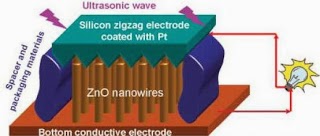
Ukrainian and American researchers have developed a pyroelectric nanogenerator. The nanogenerator can be the basis for self-powered nanotechnology that harvests thermal energy from the time-dependent temperature fluctuation for applications in wireless sensors, temperature imaging, medical diagnostics and personal microelectronics.
The researchers used an array of zinc oxide nanowires of short lengths standing on end to make a device to produce electricity when heated or cooled or even due to temperature fluctuation from day to night.
Applications of pyroelectric nanogenerator
Pyroelectric energy may bring about a new era of "tiny energy" and pyroelectric nanogenerators could be extremely useful for powering specific tasks in in-vitro biological applications, medicine and nanotechnology, particularly in space because they perform well in low temperatures. They do not contain any moving parts and could be suitable for long-term operation in ambient applications and can play key role in consumer electronics.
Carbon nanotubes for thermoelectric nanogenerator
Generally thermoelectrics are an underdeveloped technology for harvesting energy, yet there is so much opportunity. But cost has prevented thermoelectrics from being used more widely in consumer products. Available thermoelectric devices use a much more efficient compound called bismuth telluride to turn heat into power in products including mobile refrigerators and CPU coolers, but their cost is very high.
Researchers in the Center for Nanotechnology and Molecular Materials at Wake Forest University developed a fabric like Power Felt. Power Felt is a thermoelectric device that converts even body heat into an electrical current.
This device consists of tiny carbon nanotubes locked up in flexible plastic fibers. The technology uses small temperature differences like room temperature versus body temperature to create a charge. Currently, 72 stacked nanotube layers in the fabric yield about 140 nanowatts of power.
Applications of Power Felt
Potential uses for Power Felt include lining automobile seats to boost battery power and service electrical needs, insulating pipes or collecting heat under roof tiles, lining clothing or sports equipment to monitor performance, or wrapping wounded sites on the body to better track patients' medical needs. It can provide relief during power outages or accidents, when wrapped around a flashlight can powering weather radio or charge a cell phone or power an iPod. The researchers claim that they can make a jacket with a completely thermoelectric inside liner that gathers warmth from body heat, while the exterior remains cold from the outside temperature to make an effective Power Felt. They are evaluating several ways to add more and make them even thinner to boost the power output.
12/20/13 0
12/11/13
Watch the video
12/11/13 0


